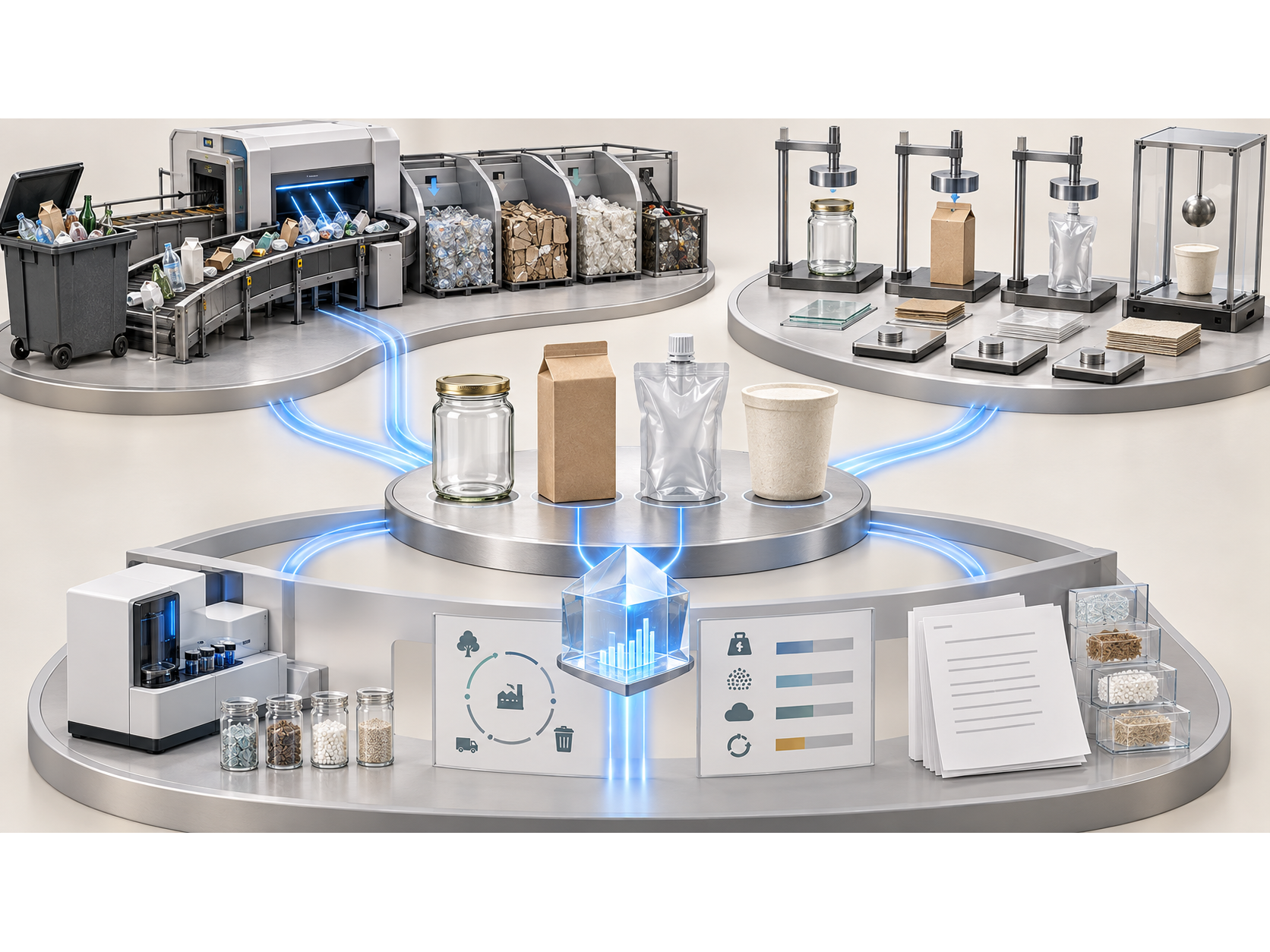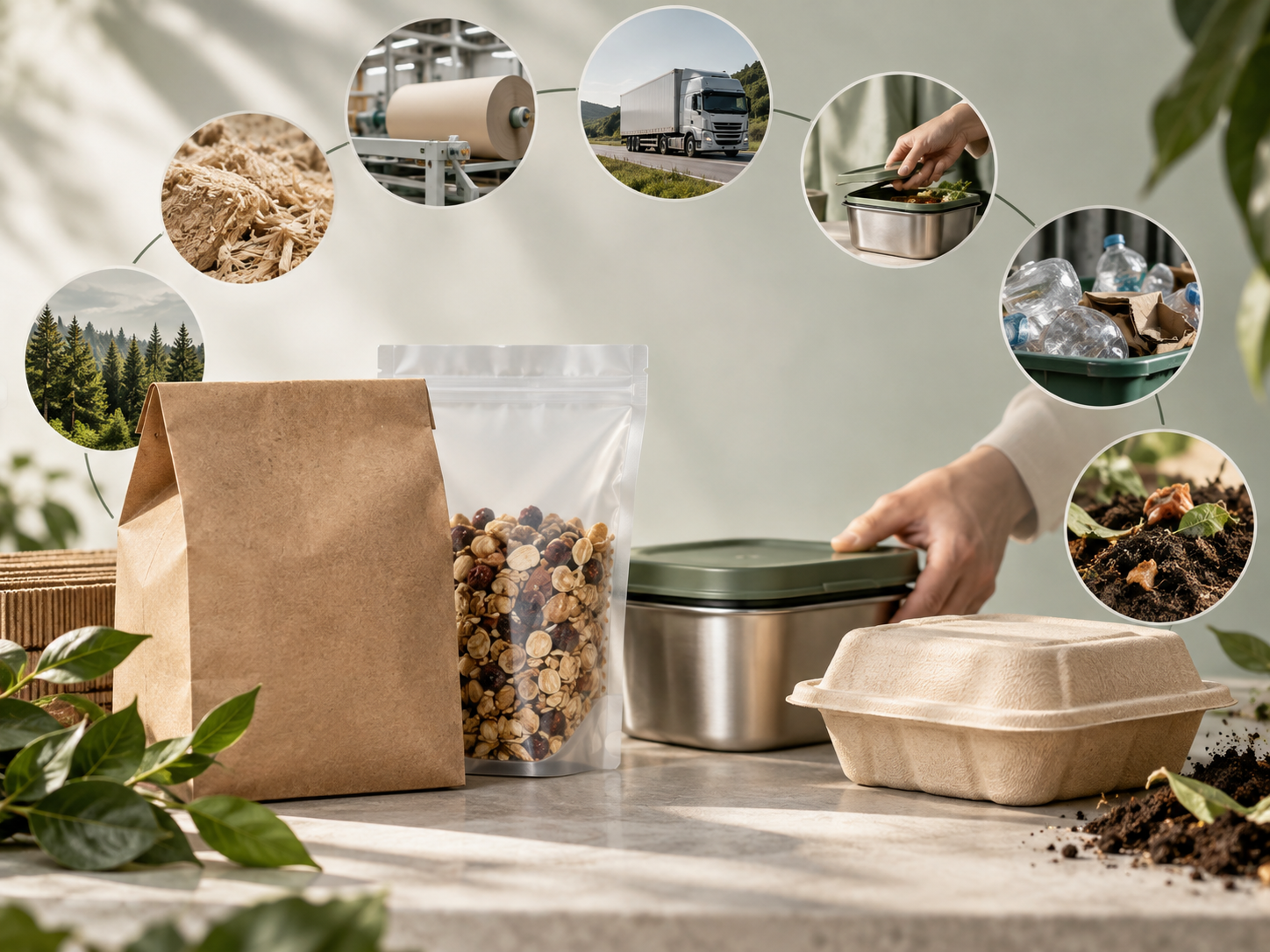
Sustainable packaging is packaging designed to reduce environmental impact across its full life cycle while still protecting the product, meeting regulatory requirements, and working in the recovery system where it is sold. That can mean using less material, adding verified recycled content, designing for recycling, building a reuse system, or choosing certified compostable packaging for a compatible organics program.
No material is sustainable by default. A paper package can use more material or need a plastic barrier. A lightweight plastic pouch can reduce freight and product loss yet have limited recycling access. A reusable container can outperform a single-use one only if it completes enough return trips. The useful question is not “Is this material green?” It is “Which design reduces the most important impacts for this product, route, and market without creating a larger problem elsewhere?”
Quick answer: Start with the package’s job, compare the complete systems against a defined baseline, verify the real recovery route, and print only environmental claims that your evidence supports.
What Sustainable Packaging Means in Practice
“Green packaging” and “eco-friendly packaging” are common shorthand, but they are too broad to work as specifications or unqualified marketing claims. In the United States, the Federal Trade Commission warns that broad environmental-benefit claims are difficult to substantiate and should be tied to clear, specific benefits. A third-party logo does not remove that obligation. The current Green Guides in 16 CFR Part 260 require marketers to substantiate both explicit and implied environmental claims.
A practical sustainable packaging brief should set measurable objectives in five areas:
Protection: shelf life, barrier, seal integrity, temperature, compression, leakage, and transit damage.
Material efficiency: package weight, right-sizing, yield, production scrap, and secondary packaging.
Circularity: reuse cycles, recycled content, collection access, sortation, reprocessing, and end markets.
Carbon and resources: greenhouse-gas emissions, energy, water, sourcing, and freight for the defined life cycle.
Claims and compliance: the words, symbols, certificates, data, and market-specific rules attached to the finished package.
These objectives can conflict. The best design is the one that resolves the product’s highest-impact trade-offs, not the one with the longest list of environmental attributes.
Does Sustainable Packaging Reduce Carbon Footprint?
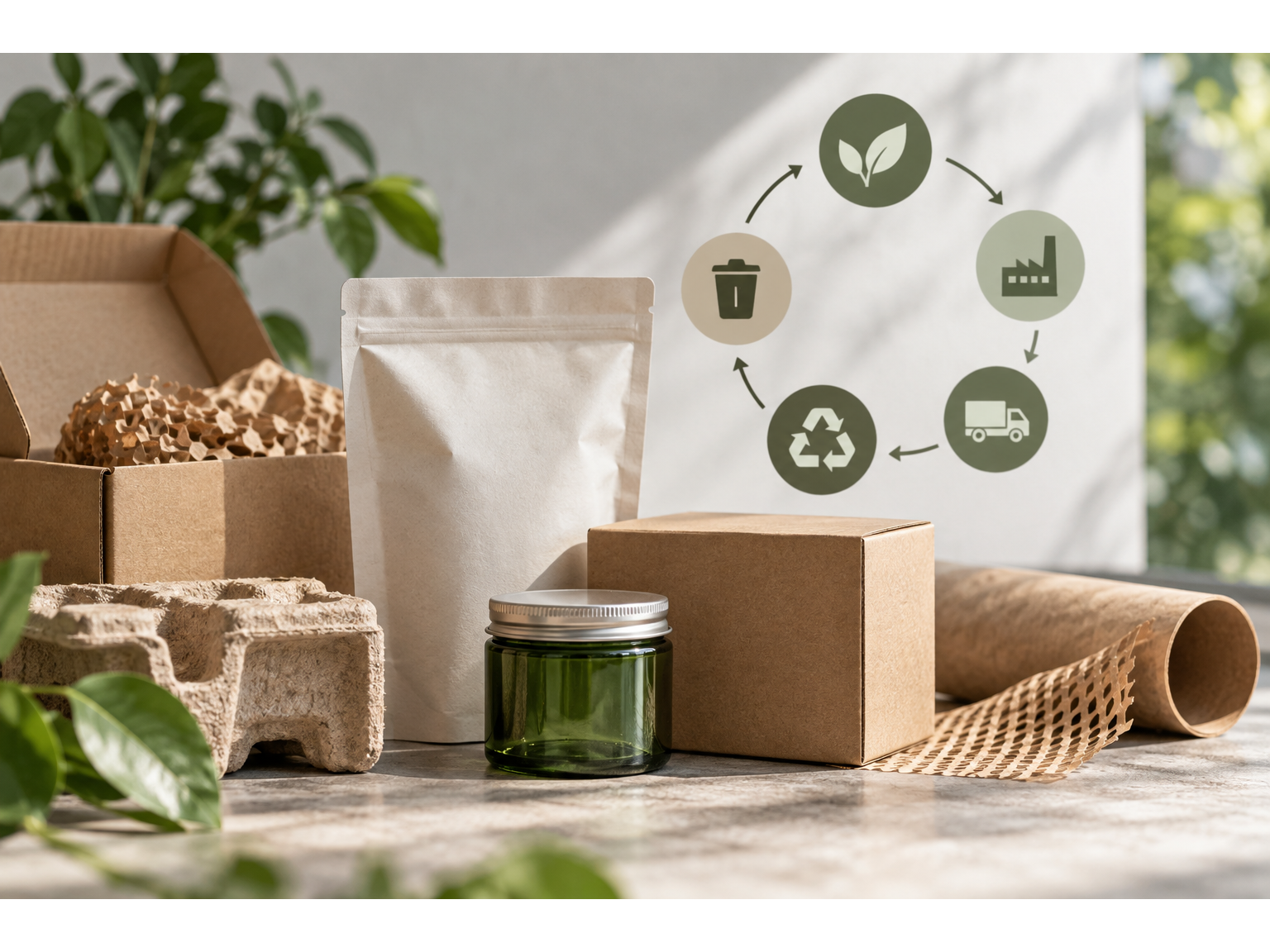
It can, but the answer depends on the baseline and the life-cycle boundary. The U.S. Environmental Protection Agency’s Waste Reduction Model compares the greenhouse-gas implications of source reduction, recycling, composting, combustion, and landfilling. EPA treats source reduction as avoiding material production in the first place and recognizes that material choices affect raw-material acquisition, manufacturing, transport, and end of life. EPA’s WARM Version 16 documentation also makes clear that different recovery pathways use different assumptions.
For a packaging project, compare at least these outcomes against the current pack:
kilograms of packaging per 1,000 delivered saleable units;
product damage, leakage, spoilage, and returns;
inbound and outbound cube and weight;
greenhouse-gas emissions for the chosen system boundary;
recycled content and the amount of virgin material avoided;
actual recovery or completed reuse trips in the markets served.
A lower-carbon claim needs a named comparison, a consistent functional unit, current inputs, and a disclosed boundary. “Uses 18% less plastic than our previous 12-ounce pouch” is more defensible than “carbon-friendly packaging.” If the new structure shortens shelf life, increases damage, or needs an added shipping case, include those effects before declaring a reduction.
Sustainable Packaging Materials List
Material names are only the start of a specification. The finished construction, coating, adhesive, ink, closure, label, product residue, and local collection system can change the result.
Material or system | Where it can work well | Main constraint to verify | Evidence to request |
|---|---|---|---|
Corrugated shipping case | Transit protection, stacking, e-commerce, established U.S. recovery | Moisture, grease, coatings, excess board, dimensional weight | Board grade, recycled content, chain of custody if claimed, loaded transit test |
Folding carton or paperboard | Shelf presentation, print quality, low shipping volume before filling | Barrier layers, windows, laminates, food-contact suitability | Fiber source, coating and adhesive specification, recovery assessment |
Mono-material PE or PP flexible packaging | Low package weight and freight volume; some designs can fit a single polymer recycling stream | Barrier, seals, attachments, sortation, and limited collection access | Full layer structure, closure and label compatibility, recyclability assessment |
PET, HDPE, or PP rigid packaging | Product protection, familiar conversion, potential PCR use | Shape, color, labels, pumps, sleeves, and local acceptance | Resin and component specification, PCR percentage, design-for-recycling review |
Aluminum or steel | High barrier and established scrap value | Mining and production impacts, lining, weight, dents, product compatibility | Alloy, recycled content method, lining and food-contact documentation |
Glass | Product compatibility, premium presentation, repeated reuse in a managed loop | Weight, breakage, closures, reverse logistics | Trip rate for reuse, damage data, recovery route, transport assumptions |
Certified compostable packaging | Food-soiled serviceware or packaging collected with organics in an accepting program | Facility access, contamination, consumer instructions, heat and grease performance | Finished-item certification, facility acceptance, artwork and collection plan |
Reusable crates, totes, or plastic pallets | Closed or controlled distribution loops | Return rate, loss, washing, empty backhaul, repair, and number of trips | Asset weight, expected trips, loss rate, cleaning process, end-of-life route |
National recovery data can help establish context, but it should not be mistaken for SKU-level recyclability. EPA’s latest national packaging figures still describe 2018. They show large differences among packaging categories, which is useful directionally, while their age is a reason to verify current market access before printing a claim. EPA’s containers and packaging data should be labeled with that 2018 period whenever cited.
Paper Packaging vs Plastic Packaging: Which Is More Sustainable?
There is no universal winner. Compare the finished packages performing the same job.
Decision factor | Paper-based package | Plastic package |
|---|---|---|
Material weight | Often heavier for the same barrier or load | Often lighter and space-efficient |
Moisture, grease, oxygen, and aroma barrier | Frequently needs a coating, liner, or separate inner pack | Can deliver high barrier with thin structures; complex laminates can limit recycling |
Recovery | Strong for clean corrugated and many paper formats; coatings and food residue can change acceptance | Strongest for selected rigid formats; flexible-film access and end markets are more limited |
Product protection | Strong in cartons and shipping cases | Strong in flexible, rigid, and sealed formats |
Sourcing evidence | Certified fiber and chain of custody can verify forest-source controls | PCR certificates and resin traceability can verify recycled-content inputs |
Freight | Flat cartons and cases can be efficient before filling; finished packs may be bulky | Lightweight formats can reduce shipping mass and cube |
Use paper when it meets performance needs without a recovery-disrupting construction or a second package that cancels the benefit. Use plastic when its light weight, seal, or barrier materially reduces product loss and when the finished format has a credible recovery pathway or verified recycled content. Avoid turning color, texture, or a resin name into an environmental conclusion.
Recyclable vs Reusable Packaging
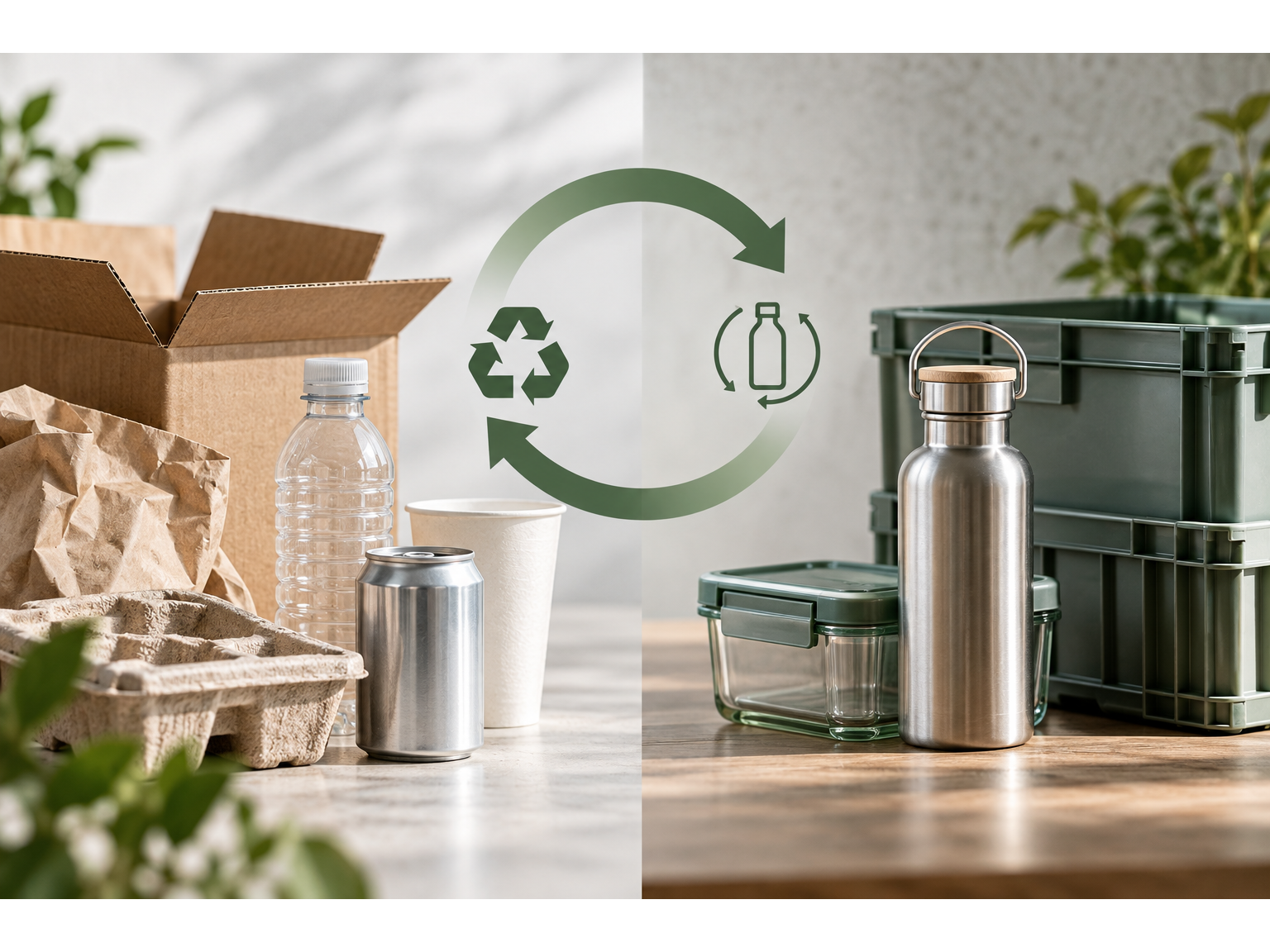
Recyclable packaging enters a material-recovery system after use. Reusable packaging remains an asset and completes repeated cycles before repair or end-of-life recovery. Reuse can avoid production of multiple single-use packs, but it also introduces collection, inspection, washing, storage, loss, and return transport.
Choose recyclable when the package is widely distributed, consumers are unlikely to return it, and collection, sortation, reprocessing, and end markets exist for the finished format. Choose reusable when the loop is controlled, return rates are high, cleaning is practical, and the package can survive enough trips to offset its heavier construction and reverse-logistics burden.
Reusable plastic pallet packaging is a good example. It can work in a pooled retailer or plant-to-plant loop with asset tracking and predictable backhaul. It is a weak fit when pallets disappear into an open network after one trip. Model the break-even number of completed uses and test a downside case for loss, damage, and empty-return distance before making a benefit claim.
Sustainable Packaging Certifications and Labels to Look For
A credible mark answers one narrow question. It does not certify that the whole package is environmentally superior.
Mark or program | What it supports | What it does not prove |
|---|---|---|
FSC chain of custody | Certified and controlled forest-based material is tracked through the supply chain | Recyclability, compostability, lower carbon, or package performance |
BPI Certified Compostable | The certified finished item meets the applicable compostability scheme and labeling requirements | Local collection, facility acceptance, home compostability unless separately certified, or lower life-cycle impact |
How2Recycle label | Component-specific U.S. or Canadian disposal instructions based on submitted package specifications | A blanket sustainability certification or identical acceptance in every community |
Verified recycled-content documentation | The claimed percentage and material source for the specified component or package | Recyclability of the finished pack, food-contact suitability, or lower total impact |
For FSC-certified paper packaging, verify that the supplier and the relevant transaction can support the claim through chain-of-custody records. FSC explains chain-of-custody certification as tracking eligible forest-based material through processing, manufacturing, and distribution.
For compostable packaging, verify the exact product or SKU rather than accepting a resin certificate for a different finished construction. BPI’s current certification program uses ASTM D6400 as its base assessment and provides optional routes for eligible coated-fiber and other constructions. For recycling instructions, How2Recycle’s label framework distinguishes Widely Recyclable, Check Locally, Store Drop-off, and Not Yet Recyclable designations by component and geography.
Compostable vs Biodegradable Packaging
Biodegradable describes a biological process, but the word alone does not state the environment, time, completeness, or effect of breakdown. Under the FTC Green Guides, an unqualified degradable or biodegradable claim for an item entering the solid-waste stream is deceptive if the item will not completely decompose within one year after customary disposal. Landfills, incinerators, and recycling systems generally do not provide those conditions.
Compostable is narrower. It requires evidence that the entire item becomes usable compost safely and within the relevant composting timeframe. A commercial-compostability claim should be qualified when the item is not suitable for home composting or when appropriate facilities are not available to a substantial majority of the markets where it is sold.
For a food-delivery startup, certified compostable packaging is most useful when it travels with food scraps into an organics program that explicitly accepts the item. It still has to pass heat, grease, leak, closure, and delivery-time requirements. If customers will put the package in trash or recycling, certification alone does not create a composting outcome.
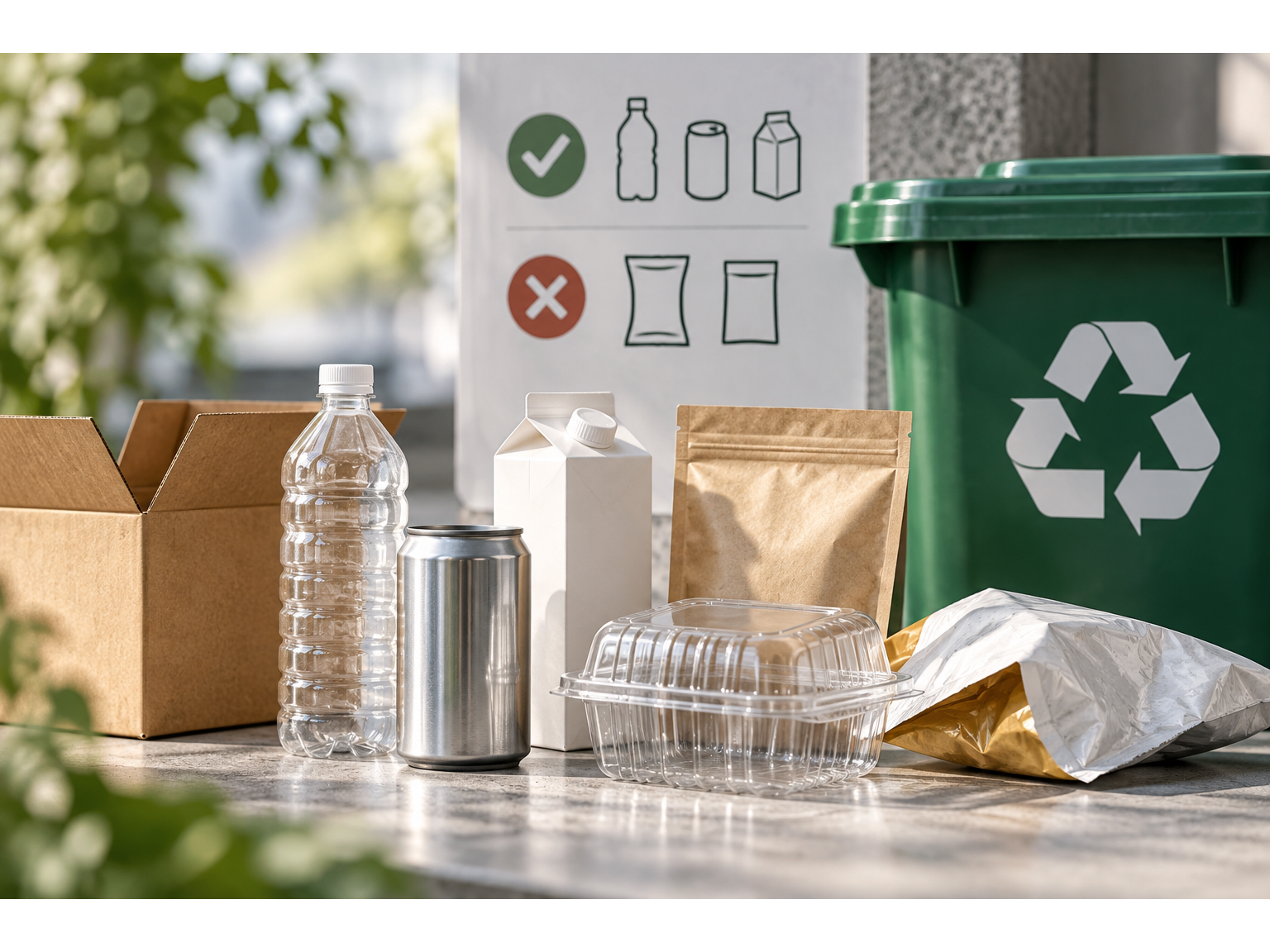
Is Sustainable Packaging Actually Recyclable?
Sometimes. “Sustainable” and “recyclable” are not synonyms. A package is recyclable only when the finished item can be collected, sorted, reprocessed, and used to make another product through an established program.
The FTC permits an unqualified U.S. recyclable claim only when appropriate facilities are available to at least 60% of consumers or communities where the item is sold. It also warns that a component, shape, size, or other attribute can make a package non-recyclable even when its base material is technically recyclable. Multi-component packages need clear instructions for each part.
California adds a separate, evolving state layer. CalRecycle says SB 343 labeling restrictions apply to products and packaging manufactured after October 4, 2026, while noting that ongoing litigation may affect that deadline. A July 14, 2026 preliminary injunction blocks enforcement of SB 343, but CalRecycle’s study and update obligations continue. Check the CalRecycle SB 343 page and obtain legal review before final artwork because litigation and enforcement status can change.
For mono-material flexible packaging, “mono-material” is a design description, not automatic proof of recyclability. Confirm the full construction, including barrier deposition or coating, tie layers, adhesives, inks, zipper, spout, valve, and label. Then obtain a market-appropriate assessment and use the resulting qualified disposal instruction.
Recycled Content Packaging Standards Need a Defined Claim
State mandates, customer requirements, and voluntary claims may define recycled content differently. Specify:
post-consumer or pre-consumer content;
percentage by weight and the component or package it covers;
batch, annual-average, or mass-balance method;
chain-of-custody or supplier evidence;
permitted variance and change-control procedure;
food-contact conditions when relevant.
The FTC requires partial recycled-content claims to disclose the amount or percentage. For food-contact plastic, recycled content adds a separate safety review. FDA evaluates recycled-plastic processes and intended food-contact uses based on source controls, decontamination, polymer, food type, temperature, contact time, and other conditions. A favorable opinion for one process does not automatically cover every resin, layer, or application.
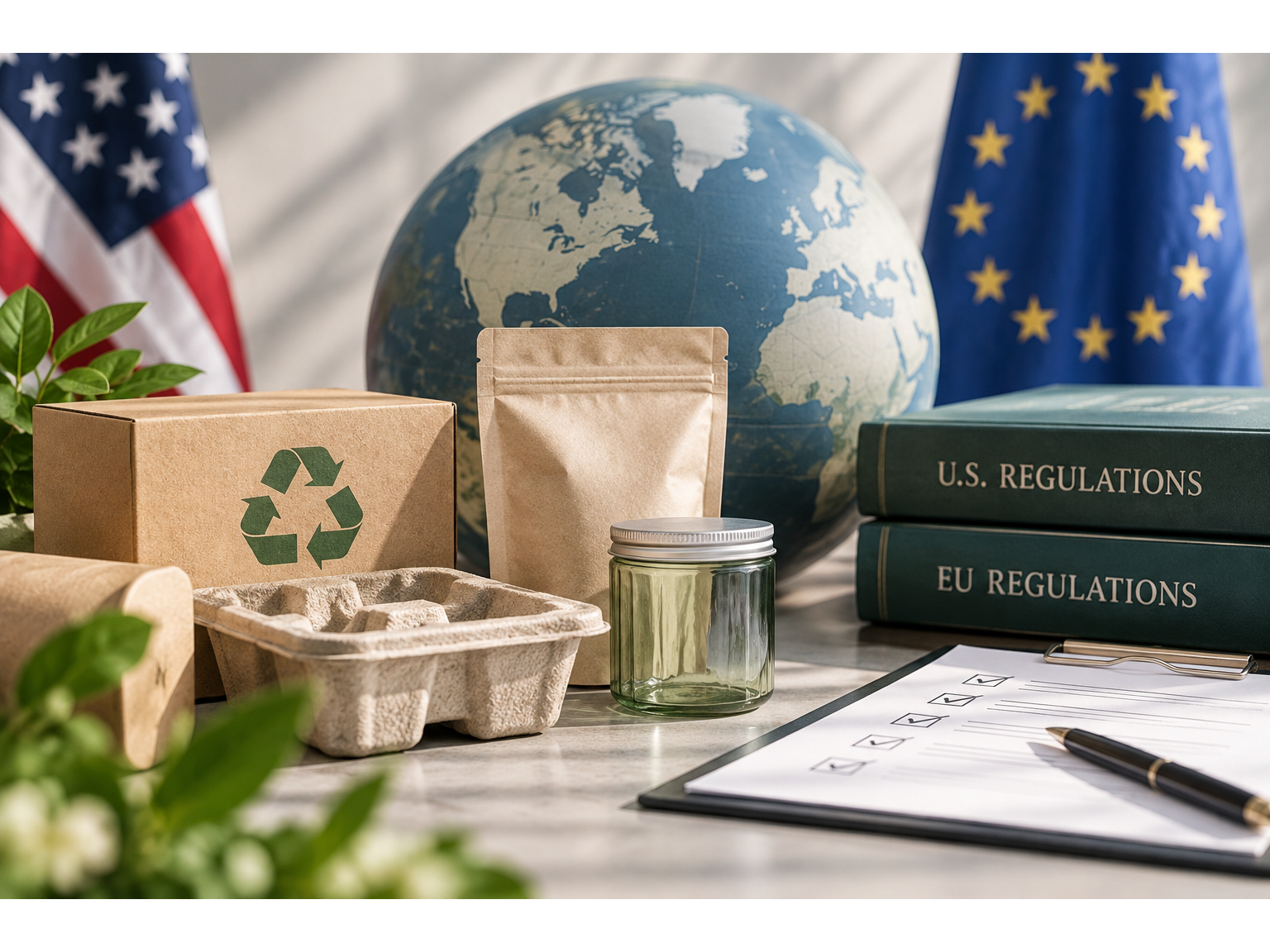
U.S. and EU Packaging Sustainability Regulations Are Different Rulebooks
U.S. brands should begin with federal claim substantiation and then map every state where the SKU is sold. Recyclability labels, compostable claims, recycled-content mandates, extended producer responsibility, PFAS restrictions, bottle deposits, and reporting duties can differ by state.
The EU Packaging and Packaging Waste Regulation, Regulation (EU) 2025/40, entered into force on February 11, 2025 and generally applies from August 12, 2026. It phases in requirements covering packaging minimization, recyclability, labeling, recycled content, and reuse. It can apply to packaging placed on the EU market even when the brand or manufacturer is outside the EU. A U.S. claim review does not establish EU compliance. See the official PPWR guidance and Dylign’s 2026 sustainable packaging trends overview for the current operating context.
Sustainable Packaging on a Tight Budget
The lowest-cost first move is usually not a premium material substitution. Work in this order:
Remove avoidable material. Right-size the package, eliminate redundant inserts, and simplify components without weakening protection.
Reduce variation. Standardize dimensions, closures, colors, and structures across low-volume SKUs where the product allows it.
Set evidence before artwork. Ask suppliers for composition, recycled content, certificates, food-contact status, and claim support before approving graphics.
Compare total delivered cost. Include conversion, freight, storage, packing labor, damage, spoilage, EPR fees, artwork versions, and write-offs.
Pilot one change at a time. Test a converted, filled, sealed package through its real distribution route before rolling out the claim.
For growing brands working at lower order volumes, fewer materials and simpler structures often produce a more durable result than buying an unfamiliar substrate solely for its sustainability story.
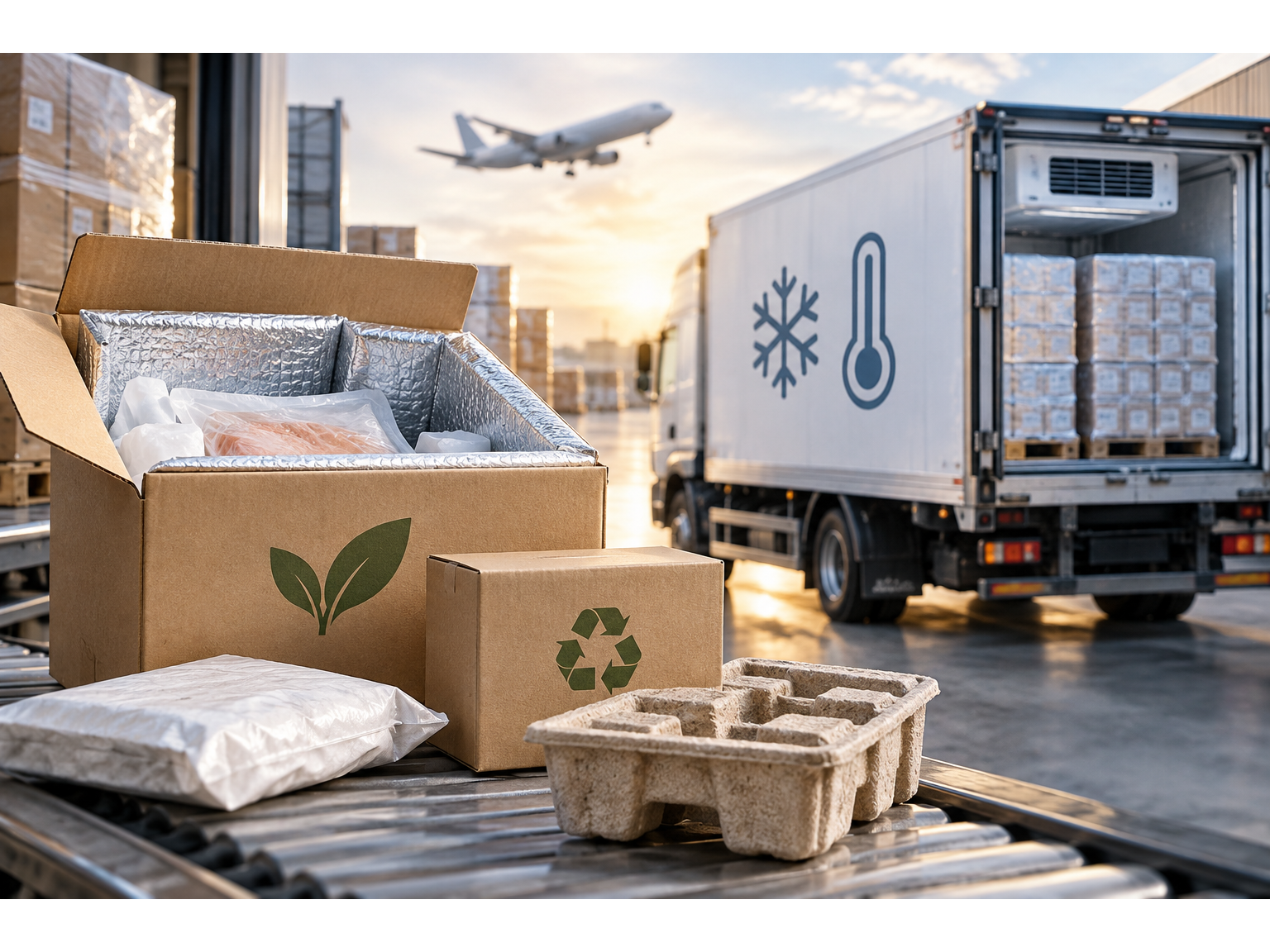
Sustainable Packaging for Cold Chain Shipping
Cold-chain packaging is a system, not an insulated material. Define the product temperature range, lane duration, ambient profile, payload, coolant, insulation, outer case, closure, pack-out, and acceptance limits. Then test the complete loaded system.
A lower-impact cold-chain design might reduce insulation mass, use a curbside-recoverable component, add recycled content, or switch to a reusable shipper. Each option still has to hold temperature and prevent product loss. For reuse, include cleaning, return transport, loss, and the number of completed cycles. For single-use systems, give component-level disposal instructions and avoid implying that one recyclable panel makes the whole shipper recyclable.
A Seven-Step Sustainable Packaging Decision Process
Define the current baseline. Record the complete pack, weight, cost, loss rate, shipping cube, and disposal route.
Set non-negotiable performance. Include barrier, shelf life, seal, temperature, food contact, transit, and consumer-use requirements.
Choose the primary environmental objective. Source reduction, verified PCR, recycling compatibility, reuse, certified compostability, or another measurable result.
Compare complete constructions. Evaluate closures, coatings, labels, secondary packaging, and shipping configuration, not just the main substrate.
Map the markets. Check collection systems, state rules, retailer requirements, and EU obligations where applicable.
Validate the package. Run conversion, filling, shelf-life, transport, and user trials on production-representative samples.
Approve claims separately. Tie every word and symbol to a current document, owner, review date, and change-control trigger.
What This Means for CPG Leaders
- Packaging and R&D: begin with the product’s functional requirements and compare complete systems on a common basis.
- Procurement: buy documented specifications, not material names. Require evidence for PCR, fiber sourcing, compostability, food contact, and change control.
- Operations and quality: validate filled-package performance and track damage, spoilage, reuse cycles, and supplier changes.
- Marketing and legal: replace broad “green” language with specific, substantiated attributes and market-appropriate disposal instructions.
- Finance: compare total delivered system cost, including logistics, losses, fees, compliance work, and obsolete inventory.
The best sustainable packaging decision is usually narrower than the phrase suggests. Define the package’s job, choose the environmental objective that matters most, prove the system performs, and say exactly what the evidence allows.
Frequently Asked Questions
What is green packaging?
Green packaging is an informal synonym for sustainable packaging. Because the phrase can imply broad environmental benefits, use it as a topic label rather than an unqualified product claim. Name the verified attribute, such as 30% post-consumer recycled content or a qualified recycling instruction.
What is the most sustainable packaging material?
There is no universal best material. The answer depends on product protection, package weight, manufacturing, transport, reuse or recovery, local infrastructure, and the comparison baseline.
Is FSC-certified paper packaging recyclable?
Not automatically. FSC certification addresses forest sourcing and chain of custody. Coatings, laminates, windows, adhesives, food residue, and local collection determine whether the finished paper package can be recycled.
Is mono-material flexible packaging recyclable?
It may be better aligned with a single polymer recycling stream, but recyclability depends on the complete structure and the available collection, sortation, reprocessing, and end market. Use an assessment for the finished package and qualify the claim.
Is compostable packaging better than recyclable packaging?
Only when the package fits an accepted organics stream and helps collect food scraps or another useful feedstock. Where composting access is absent, a recyclable or source-reduced package may produce a better real-world outcome.